
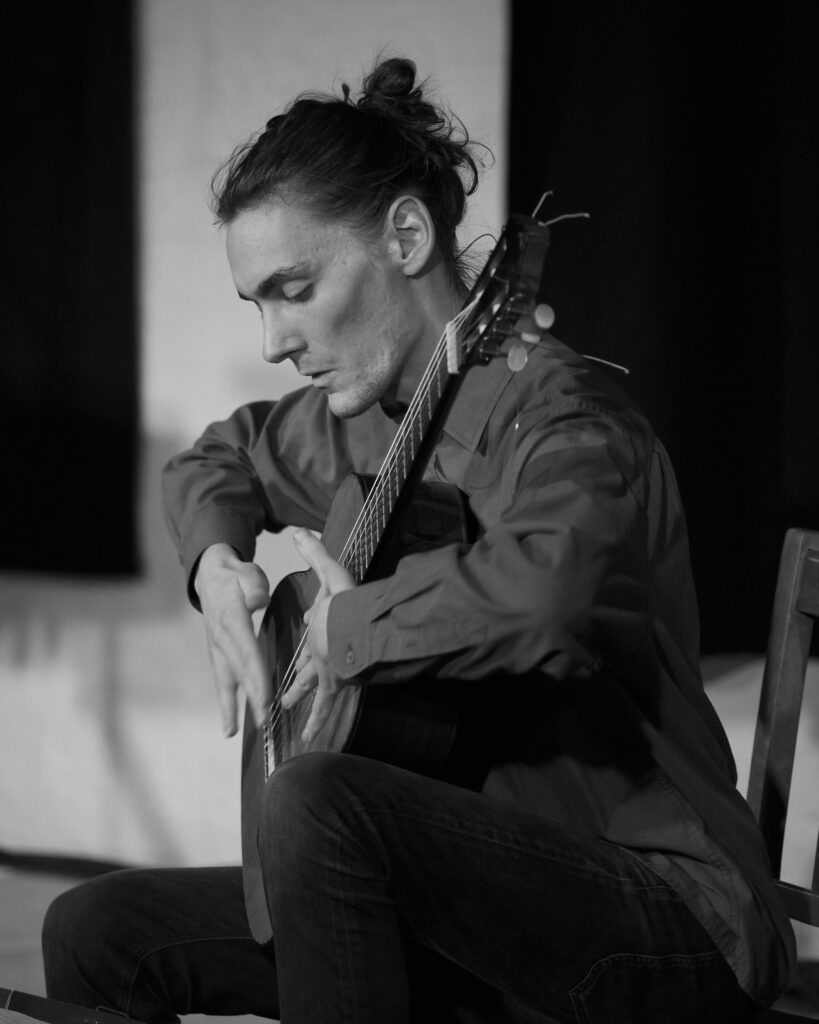
Mark Reid Bulatović is a guitarist and composer from Slovenia and Scotland. His artistic interests are placed at the intersection of microtonality, intimacy and ritual.
As a performer he is interested in inviting other creative practices into aspects of the concert experience – notably, a host of extra media, including sound installation, puppetry, video and theatre in an attempt to deflect attention from the performer and give space to a broader concept.
In 2023 he was the recipient of the Pro Musica Säätiö grant for promising young musicians. (Photo credit: Point of View)
it’s either “headlining” or, “the graveyard shift”
It’s always nice to bring a project to an environment different to where it was conceived; Last year’s trip to Huddersfield Contemporary Music Festival (hcmf//) certainly re-contextualised and affirmed to me the motivations of the concert length work Animistic Rituals composed by Þorkell Nordal in collaboration with myself.
The piece was born from a fascination with the latent ritualistic properties of concerts and the cultish habits of guitar-brotherhood. As with any artwork, “a dance between what you like and a mysterious process”1 has been driving the direction, so some two years have passed with various iterations and ongoing conversation, before the piece is considered “complete” and being taken abroad.
Yet still, even this iteration dormant features seemed to become awakend in the world Thorkell has evoked with this piece – one which I believe to be a substantial offering to the guitar cannon.
As the solo performer, many interpretive tasks rest on my shoulders and so I’m considering how this return to the north of England is particularly relevant to me and the piece. Before moving to Finland and COVID, I spent four-roller-coaster-years at the Royal Northern College of Music (RNCM) in Manchester – just a stone’s throw from Huddersfield. Alongside the gig we’ve planned a little lecture recital at the college, so, whether I like it or not, I am in constant conversation with a specific period from my past; interrogating how I was living then, what was pushing me to practice, how the social dynamic was stewarded by those at the top of it and so on…
In many ways I hadn’t previously realised, the work’s fascination with the topics of religiosity, cult dynamics and practice were my lived reality during my time in Manchester – as a younger lad, I was privy to being swept up in such things, as were many of us guitarists it seems. “Work Hard / Play Hard” was the motto that permeated that time, affecting almost every aspect of life: co-habitation with other guitarists (fret-turnity) supported intensive practice sessions, a thriving experimental scene pushed us ever more avant-garde and even ecstasy induced partying ended up in heartfelt affirmations of each others playing in guitar class – so work and play were manifesting as one, a training for a bipolar life of extremes, hard as it is unsustainable.
Some of us made it through; others, almost as a trauma response, moved on without contact; another still, didn’t get to the other end of it.
So these things are swimming in my head as I sit on the flight from Helsinki to Manchester, as well as the feeling of “we’ve made it!” playing at this world renowned festival. If it was a cocktail it would be prosecco chased by frosty jacks.
The recommended way of arriving to any post-industrial English town is indisputably the train: We roll through the hills of Yorkshire gliding through interlocking belts of poverty and wealth. Huddersfield itself was a former mining town, the centre boasting ornately decorated buildings that have fallen into decay since Thatcher (?). It’s a departure from the socially optimised Nordic city planning I have subconsciously gotten used to in Helsinki.
Immediately after departing the train, we rush toward St. Paul’s Hall, where composer in residence, Sarah Hennies’ hour long string quartet Borrowed Light is being performed by Mivos Quartet. A Q&A after the stunningly physical performance, revealed that the piece was conceived from and interest in the quakers – a fringe religious group from the early colonial period of America.
In addition to the resident composer, this edition of hcmf// has a particular focus on composers from the Baltic region, especially from Finland. So Finnish chatter is heard, and familiar faces happily greeted! We continue on to the hotel from there.
The days programme contains three more performances; Lady Sapiens, which we unfortunately miss; London Sinfonietta, with stand out works by Liisa Hirsch and Marta Śniady; and finally Estonian Electronic Music Society Ensemble (EMA), that is popular enough to be completely sold out! So much to our chagrin, as we had common friends performing there, we get turned away at the door – a novel experience in its own right for the kind of events I tend to frequent.
It is now the next day. After a breakfast of beans on toast, begins the marathon “shorts” programme – around the clock almost back-to-back performances in the various venues around Huddersfield centre. The day is completely free to attend, promising even more audience than the previous day’s full house. Included among the audience are some members of my family and friends from the good ol’ Manchester days.
Our performance is set to happen in the Bates Mill Photographic Studio located in an old industrial courtyard. it’s either “headlining” or, “the graveyard shift” depending on your perspective. We’re performing last at 23:20 – regardless, we had plenty of time to prepare. Pre-performance drowsiness is cured with a nap, which preludes the preparations for the initial conditions of the piece:

As it was a Monday nowhere was really open after midnight. So we celebrated with a local delicacy of gravy and cheese on chips on a street bench – we haven’t eaten anything green since setting foot in the UK two days ago.
An intense conversation about the application of Stanislawski’s method to music performance, leaves some unresolved tension in the air… The following day, on a mixture of cholesterol and nostalgia we travel to Manchester (to the RNCM) to present a lecture recital to the guitar and composition departments.
We are generously hosted in Manchester by Borna Kuća, whose exceptional balkan band Chuva is performing that very night in a hip new event series in Withington. The Mancunian suburb bears a striking resemblance to Huddersfield, though pints are dearer.
I think one of the key ways in which hcmf// retains its quality and reputation is for its non-pompous, practical attitude toward art. Of course, there are different types of venues, the aforementioned St. Paul’s Hall has high-quality acoustics, and the Town Hall is extremely posh and decadent looking. But there is a humane feeling to being in this town; many audiences travel to the festival, which perhaps helps to maintain an experimental and committed attitude. Ready to receive and reciprocate whatever weird or not or minimal or complex or performative or serious music, that has been curated by Artistic Director, Graham McKenzie.
Clearly, the festival in itself is driven by what Graham likes, and the incredible effort the hcmf// team put into realising that year in, year out. It will remain a mystery as to why this little town became such a heavyweight in the contemporary music scene, all I can say is enjoy it as a work of art in its own right!
As a final note , fellow Helsinki-based-experimental musician, Lauri Supponen has just been announced as the hcmf// 2026 composer-in-residence! So it seems there will be yet more of Finland gracing Huddersfield – great news for a pairing that fits like nyrkki silmään2.
- Morrison, Taylor [@WeOpen]. Instagram, 8 April. 2026, https://www.instagram.com/p/DW30938DY2I/. ↩︎
- “Fits like a fist to the eye”, a Finnish saying meaning fitting particularly well together. ↩︎
Leave a Reply