
W. H. Y. S. O. U. N. D?
If a DVD of David Lynch’s 1978 film Eraserhead was shown as an installation, would that then become “video art”? I think not.1
Sound art emerges as a concept and perhaps even more insistently as a genre, only in recent times.
There are many perspectives on why this has happened, but here I will try to condense them (and inevitably lose some depth) into two broad ideas:
1. as a consequence of a shifting perception of what the primal material of music is in the decades mentioned before (60s and 70s);
2. and a pragmatical term for curator to account sound into the world of museum (Annea Lockwood)2.
This article is going to explore the first idea.
Is music only about sound?
Or is it also the Composer? the songwriter? the Pygmis orality?
The violinist in the city fest? Or the punk band that still plays in the squat?
If we reduce music to sound alone, we risk forgetting that this web of roles
we3 have created are part of what we call music.
Sound by itself is never enough: it is always already bound to a network of human agents, institutions and rituals, economies and desires. The material of the music is never pure, alone.
It is partly social, hierarchical and vast. But then, I should ask: is sound somehow purer within sound art practices?
Or is sound art itself yet another attempt to preserve the illusion of purity, a curatorial strategy, a linguistic prosthesis, a way to sound more conceptual, perhaps even cooler, at the end of the day?
Sound, and the arts that came from it, are strange things.
Differently for the painting, sculpture or video technology in multimedia art they are intrinsicable based on light and how we perceive it but yet, we don’t talk about “Light art”.
Contemporary visual arts are of course divided into their sub-categories: sculpture, painting etc.
When we talk about “sound”, which is a physical property of the compression and expansion of molecules of air in a time frame, we talk about it as both a physical property and an aesthetic one, a phenomenon into a form. There is no division in sound art whether it’s an installation, a score, a soundwalk etc.
There is a reason why this could have happened, its answer could be found in the history embraced with it:
Sound was a medium of knowledge, a speculative practice through which harmony, proportion, and the very order of the cosmos could be apprehended. The methods of tuning developed by Pythagoras in ancient Greece and those of Sanfen Sunyi in ancient China reflect the same approach, where sound served as a means to explore and understand the physical structure of the world.
To go a bit further in medieval times sound started to be considered music and it belonged to the studies of quadrivium (the four ways) together with arithmetics, geometry and astronomy.
To study and explore sound is a description action rather than a prescription. It is an inquiry into perception itself: one can imagine its behaviour, but sound only truly exists when actuated in space, when vibration meets air, the space, and the body. Its form is never purely conceptual, it must somehow be realised.
For a long time tendencies and practices in sound were only observed and cataloged upon analysis, after the fact.
Furthermore, sound started to shift in a strange way surrounding only in music not any more in the world of speculation and science.
This is a complex matter (sorry to repeat it so many times) but this shows a really important thing: what happened? Is the hedonistic part of sound more interesting than its speculation?
One need only recall that Beethoven’s sonatas, however monumental they may now appear to us, however grand their sonic architecture were also, in their time, the marginal ornament of a bourgeois Saturday.
Within the exploration of the 20th century this changed a lot in many ways: music started to be thought of in a more abstract way, giving sound the force to be a speculative force again (an example could be the serialism: after long time what was in the paper was as much as important what was played).
I want to highlight a piece I’ve been working on for more than three years: Gentle Fire, by Alvin Lucier.
The work consists of transforming a “sound image” (afaik a sound), present in a list, into another sound image, part of a second list.
This process should be slow and clear. Some sound images written in the lists are sound events from the environment, others are speculative and imaginative.
In the last part of the score Lucier writes this:
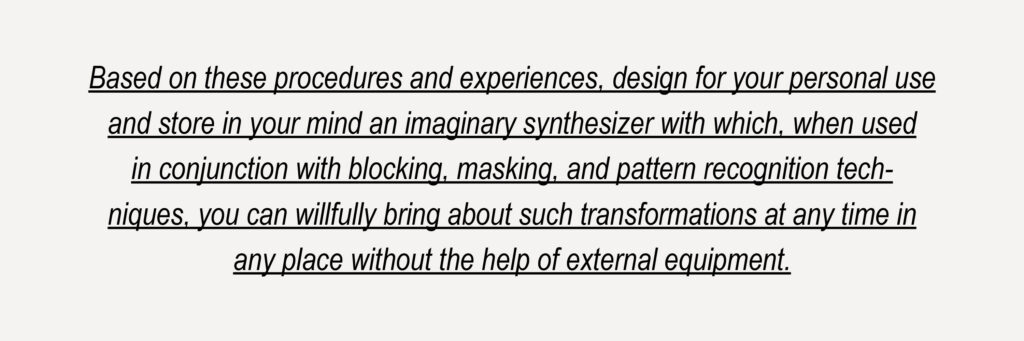
Within this short passage lies something essential. Sound is no longer conceived only as something to be experienced, but as a medium of relation.
Lucier’s instruction shifts the act of listening and the making of a piece inward: it proposes an exercise of the mind and of perception, one that no longer depends on instruments, technologies or sound itself, but on the capacity to imagine listening and transform internally.
It is perhaps the most demanding form of sonic practice, because it takes place entirely within us, respecting what is the true identity of sound: its intangibility.
What marks the threshold between music and sound art is not merely a question of medium or form, but rather the mode of speculation inscribed at the core of the artistic act as mentioned before.
Music, as codified within its traditions, tends toward permanence and repeatability; sound art, by contrast, often grounds its speculative force in impermanence, in the practical gesture of making audible which resists permeability in a space.
If music tends to realise something into time and then start to spread into the space and the things that are around it, sound art tends to start within the conceptualising a space (not always physical as we saw before), then slowly reaching the time or, maybe, not at all.
It may sound pedantic, but when encountering a work that situates itself within what we call sound art, the most important thing to observe is its mode of speculation not as an object, but as a possibility of thought.
Sound art often operates less as a composition and more as a proposition in a space, time, object. Sound in sound art is a gesture that invites us to think through sound rather than about it.
Speculating.
- Alan Licht, “Sound Art: Origins, development and ambiguities”, 2009. ↩︎
- “Sound art. I find it a useful term….Nevertheless, perhaps the term was pragmatically conjured up for/by museum curators to account for sound’s acceptance into their world.” cited by Alan Licht, ivi . ↩︎
- I did not create anything, as I imagine you did not too – but we (again) are caught in the paradox of what came before us. A disaster that we didn’t foresee and we will not understand fully. We are not pure, and our art becomes mirror of our fault strategy and that is a problem that we need to address while we think we are creating something new. ↩︎
Leave a Reply